How Amorphous Solid Dispersions
Improve Drug Delivery
Overcoming poor solubility remains one of the biggest challenges in pharmaceutical development. This critical factor determines how well a drug dissolves, absorbs, and delivers its intended therapeutic effect for patients.
Amorphous solid dispersions (ASDs) are used for complex formulations to address poor solubility by stabilizing drugs in their high-energy amorphous state - rather than their more stable but less soluble crystalline form. Compared to conventional formulation methods, ASDs can offer more predictable absorption profiles, reduced dose variability, and the potential for lower dosing, all of which contribute to better patient outcomes and greater commercial success.
In this article, we explain what ASDs are, how they work, and why partnering with a specialized CDMO can help you bring these innovative therapies to market successfully.
The Challenge of Poorly Soluble Drugs
A significant challenge in modern pharmaceutical development is the high proportion of new drug candidates that display poor water solubility. Estimates suggest that as many as 70–90% of compounds in today’s drug pipelines exhibit poor water solubility; a trend fueled by advances in medicinal chemistry that have produced more complex and lipophilic molecules. When a drug cannot dissolve effectively in water, its absorption in the gastrointestinal tract is severely limited, thus resulting in reduced bioavailability and diminished therapeutic impact.
This creates substantial hurdles for both drug developers and patients. For pharmaceutical companies, poorly soluble APIs often lead to lower success rates in clinical trials, increased variability in patient response, and higher development costs due to the need for additional formulation work or repeated studies. In some cases, promising drug candidates are abandoned altogether because conventional formulation methods cannot overcome their solubility challenges.
For patients, this translates into fewer effective treatment options and the risk of inconsistent therapeutic outcomes, which may require higher or more frequent dosing and increase the likelihood of side effects.
Solving this issue usually leads to conventional approaches - investigating salt formation or particle size reduction, for example, yet they are often insufficient for the most difficult compounds. To find solutions to this challenge, drug developers can focus on physical methods such as formulating their drugs into amorphous solid dispersions to enhance solubility and bioavailability for more effective drug delivery.
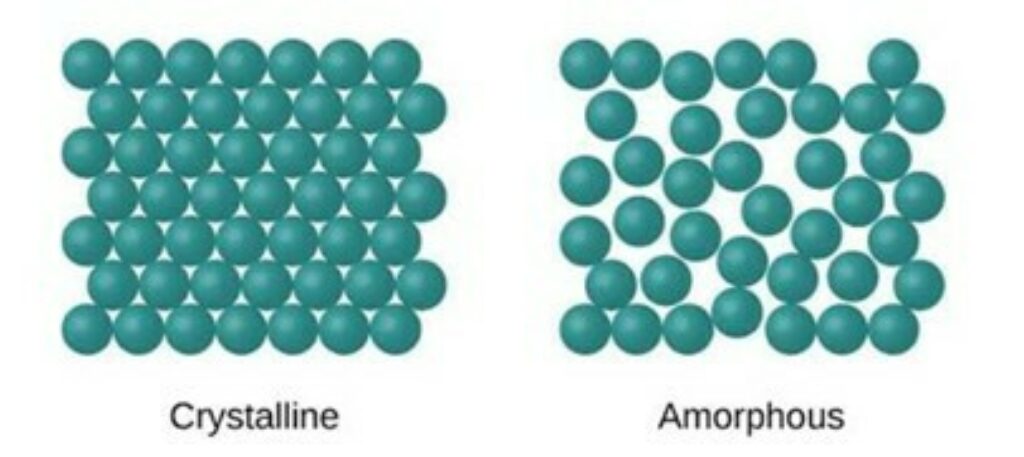
Crystalline v/s amorphous lattice structure
One important structural factor is whether a drug exists in a crystalline or an amorphous form - that significantly impacts its solubility and absorption.
Crystalline drugs have molecules arranged in a highly ordered, repeating lattice structure that often results in low solubility and slow dissolution rates due to tightly packed molecules that require more energy to break apart in solution. Amorphous drugs lack this long-range molecular order. The molecules are arranged randomly, resulting in higher free energy and increased molecular mobility, and this disordered structure makes amorphous forms significantly more soluble and faster to dissolve in aqueous environments compared to their crystalline counterparts.
The Scientific Rationale Behind ASDs
Although the primary rationale is to address the limited solubility and slow dissolution rates that often hinder the effectiveness of many pharmaceutical compounds, amorphous solid dispersions offer several key benefits that collectively improve drug performance.
Higher solubility: The amorphous form of the drug has increased solubility, allowing higher concentrations to be available for absorption.
Faster dissolution: ASDs dissolve more quickly than crystalline forms, supporting a more rapid onset of action.
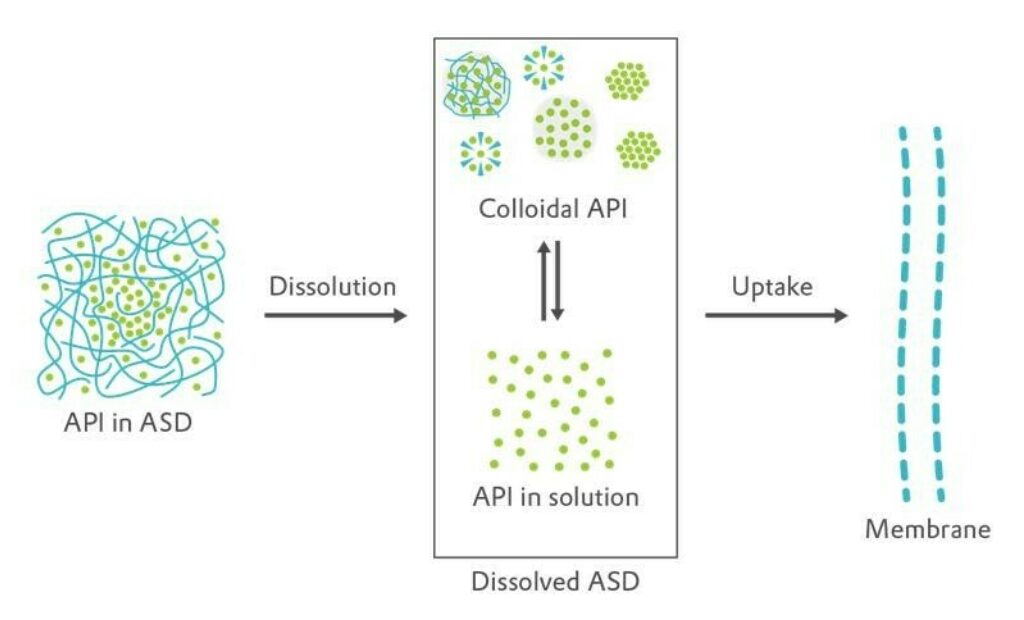
Prolonged absorption window: The polymer matrix helps maintain the drug in a supersaturated state as it moves through the gastrointestinal (GI) tract, extending the time available for absorption and maximizing bioavailability.
Drug uptake from ASDs into the intestinal membrane, adapted from Schittny et. Al
The benefits of ASDs are clear, but successfully preparing drugs into ASDs is a challenge that many drug developers face.
How Are Amorphous Solid Dispersions Prepared?
ASDs are typically prepared by dispersing the API within a polymer matrix, which helps prevent the drug from reverting to its more stable crystalline form.
The first step is to identify a polymer - critical to the success of ASD formulations - to stabilize the amorphous form of the drug and inhibit recrystallization during storage and use. The API and polymer can then be processed via various manufacturing techniques.
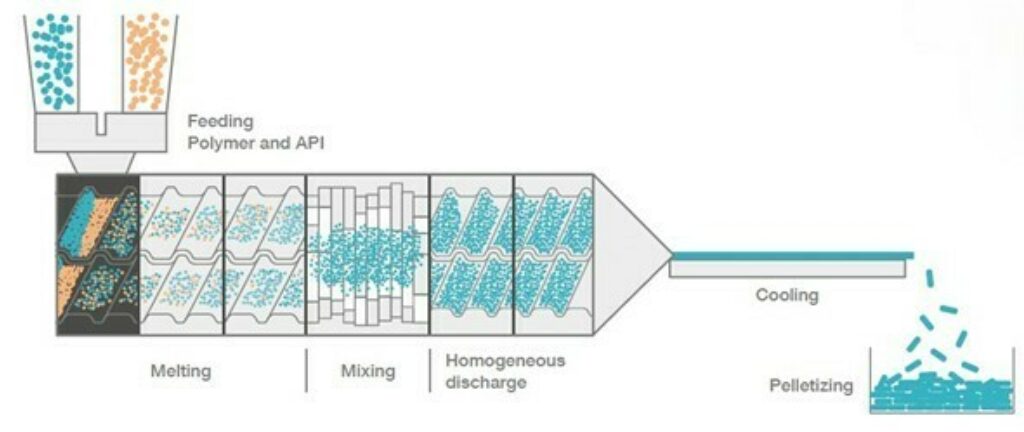
One widely used method is hot-melt extrusion, a melting technique. The API and polymer are heated and mixed until they form a homogeneous melt. This mixture is then cooled and solidified, resulting in the drug being trapped in an amorphous state within the polymer.
Another popular approach is spray drying, a solvent evaporation technique in which an API and polymer are dissolved together in a solvent and then rapidly dried using a stream of hot gas. This process quickly removes the solvent and leads to the formation of fine amorphous particles.
Hot melt extrusion method:
Spray drying method:
Aenova’s CDMO Services for Amorphous Solid Dispersions
Whilst simple in theory, the formulation and scale-up of ASDs requires a nuanced understanding of drug-polymer interactions, the prevention of drug crystallization, and the optimization of manufacturing processes. Transitioning from laboratory-scale batches to commercial production further complicates matters, as changes in processing conditions can impact the physical stability, dissolution profile, and bioavailability of the final product.
CDMOs are leaders in addressing these problems through specialized expertise and access to advanced technologies. Additionally, a CDMO’s infrastructure helps sponsors to accelerate development timelines and reduce technical risks without the significant capital outlay that many pharmaceutical companies may not be able or willing to make internally.
At Aenova, we are a leading provider of contract development and manufacturing services, with a strong reputation for excellence in the field of ASD development and production through capabilities that span the entire lifecycle of drug products. With our integrated services, advanced technologies, and commitment to quality, we ensure pharmaceutical companies efficiently bring high-quality ASD-based products to patients worldwide.
Our formulation experts collaborate closely with clients to design and optimize amorphous solid dispersion systems tailored to each compound’s unique properties. By combining deep expertise in drug–polymer interactions, stabilization techniques, and process development, we help improve bioavailability and ensure robust product performance.
To support each stage of development, we apply state-of-the-art analytical methods to characterize the physical and chemical properties of ASDs, perform in vitro dissolution and stability testing, and verify that final products consistently meet stringent quality and regulatory standards.
Final Thoughts
As amorphous solid dispersions continue to revolutionize drug delivery by overcoming the limitations of poorly soluble drugs, their success is often attributed to the knowledge and expertise of the team behind the development and manufacturing.
At Aenova, our experience as a pharmaceutical CDMO means that we have the knowledge and expertise to successfully unlock the full therapeutic potential of challenging APIs for drug delivery.
If you need support in developing or manufacturing your drug candidate for successful drug delivery, we encourage you to reach out to discuss your challenges with our formulation experts.
Reference: Schittny, A., Huwyler, J., and Puchkov, M. (2020) Mechanisms of increased bioavailability through amorphous solid dispersions: a review. Drug Delivery, 27 (1), 110–127.






 LinkedIn
 Instagram
 Facebook